

Evaluate a digital marketing agency by first defining your goals, target audience, budget, channels, and KPIs. Match those needs to the right agency type, whether SEO, PPC, content, boutique, or full-service.
Check relevant industry experience, case studies, testimonials, and measurable results like ROAS, leads, conversions, and revenue impact.
Ask about process, timelines, reporting, ownership of accounts and data, contracts, pricing, and team access. Next, you’ll see how each factor helps you make a confident choice.

Define Your Goals Before Hiring an Agency
Before hiring an agency, define exactly what you want to achieve. Clarify marketing needs, business goals, and the challenges you want addressed.
Identify your target audience, desired outcomes, and priority channels before consulting. Set measurable KPIs like CPA, ROAS, conversion rate, qualified leads, or revenue growth to evaluate performance objectively.
Separate short-term wins from long-term goals, then connect each goal to your broader marketing strategy. When you communicate this direction clearly, agencies can recommend relevant services and demonstrate whether they understand what success looks like.
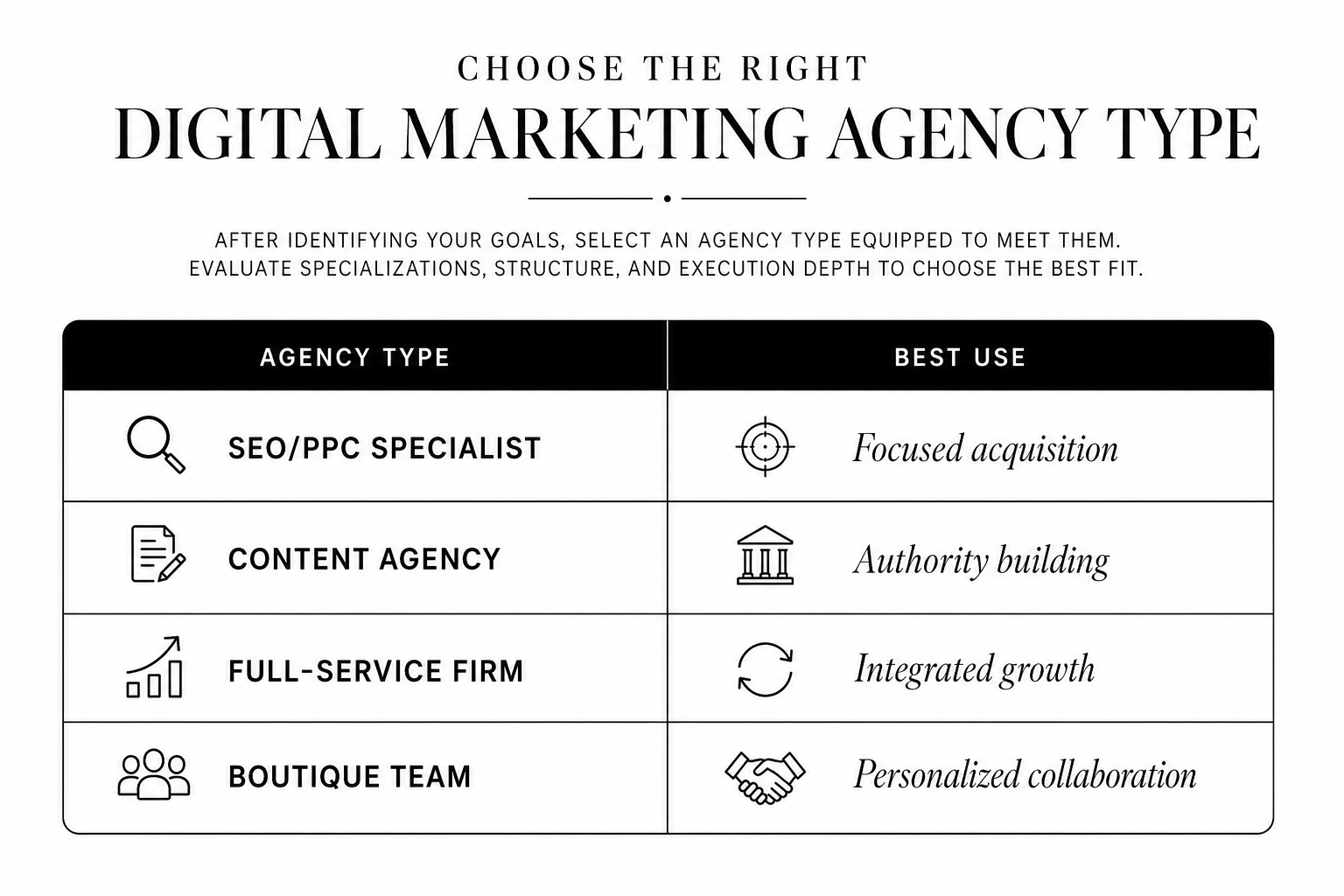
Choose the Right Digital Marketing Agency Type
After identifying your goals, select an agency type equipped to meet them. Evaluate specializations, structure, and execution depth to choose the best fit.
Assess what each agency offers, then weigh important criteria: decision speed, senior expertise, fresh thinking, service breadth, and cultural fit. Don’t chase size alone. Choose the model that matches your operating rhythm, complexity, and performance expectations.
Check Relevant Industry Experience
How well does the agency understand your market? You need relevant industry experience because sector nuances shape messaging, channel choices, compliance, and buyer psychology.
Ask whether the team has served businesses like yours and understands your competitive landscape, including emerging threats and overlooked opportunities. A proven track record signals they can convert industry insight into campaigns that resonate.
Confirm they know the software, platforms, and data sources your sector uses, so execution won’t stall. Request references or case studies here, but focus on fit: agencies should turn prior knowledge into strategies for your goals.

Review Case Studies and Client Results
Relevant industry experience matters most when the agency can prove it through real client outcomes. Study case studies with disciplined scrutiny, not casual interest. You’re looking for evidence that the strategy translated into measurable results tied to business goals.
Verify metrics: traffic lift, conversion gains, ROAS, revenue influence.
Read client testimonials for reliability, communication quality, and satisfaction.
Compare industries to see how they handled industry-specific challenges.
Don’t accept vague wins like “more engagement.” Provide demand numbers, context, and a clear timeline for results. Strong agencies show what changed, why it changed, and how their work created durable performance.
Ask About Process, Timelines, and Ownership
Before signing, ask the agency to walk you through how they plan, launch, manage, and optimize campaigns.
Press for their process for building marketing strategies around your goals, not templates.
Demand realistic timelines for deliverables, learning periods, and measurable outcomes, so you can separate ambition from operational discipline.
Clarify ownership of content, accounts, data, creative, and performance insights before work begins. You should retain strategic assets you’ve funded.
Also define communication cadence, escalation paths, reporting formats, and decision rights.
Strong agencies welcome collaboration, train your team, and transfer knowledge so progress doesn’t depend on secrecy or dependency.

Check Channel Expertise and Service Focus
Match the agency’s channel strengths to your needed outcomes. A capable agency shows expertise in SEO, PPC, social media, and email—not just broad claims. Test depth, not surface fluency.
Ask which platforms they master, such as Google Ads, Meta Ads, or marketing automation tools.
Review case studies proving performance in channels tied to your business needs.
Ensure their service focus aligns with your objectives, constraints, and growth model.
If you need multi-channel marketing, verify they integrate channels strategically rather than run disconnected tactics. You’re hiring precision, not a menu of services.
Ask How the Agency Tracks ROI and Reports
Ask how the agency will prove its work drives results. Clarify which metrics define ROI for your goals: CPA, ROAS, CLV, pipeline, or sales growth.
Don’t accept vanity dashboards. Require reporting that connects campaign performance to business outcomes and explains what the data means.
Check its record with similar measurement challenges. Strong agencies use analytics to map journeys, identify friction points, and guide optimization.
You should get transparent access to performance data, attribution logic, and KPI definitions. Transparency lets you judge whether strategy, spend, and execution are improving results or just generating motion.
Compare Pricing, Contracts, and Team Access
What are you paying for, and who does the work? When you compare pricing, demand clear line items for strategy, creative, media, reporting, and management. Hidden fees hurt ROI and weaken control.
Evaluate contracts for accountability:
Defined deliverables, timelines, and specific metrics
Flexible terms tied to performance adjustments
Required updates on budget use and campaign results
You also need direct team access. Ask who owns your account, who executes the work, and what expertise they bring.
Don’t accept vague “team” promises. Strong agencies expose talent, clarify costs, and commit to measurable performance before you sign anything with confidence.

Frequently Asked Questions
What Is the 3-3-3 Rule in Marketing?
The 3-3-3 rule balances three pillars: authenticity, engagement, and measurement. You align messages with values, engage audiences through value, interaction, and listening, and track CAC, ROAS, and CLV to drive sustainable growth.
How to Value a Digital Marketing Agency?
Like a ledger in a spaceship, you value it by auditing revenue, margins, retention, client concentration, case studies, tech partnerships, KPIs, and growth systems. Don’t ignore culture, transparency, or industry fit; they predict durable performance.
What Is the 70/20/10 Rule in Digital Marketing?
You allocate 70% to proven channels, 20% to promising emerging tactics, and 10% to experiments. You’ll protect performance, test innovation, manage risk, and use results to refine smarter, more adaptive digital marketing decisions.
What Are the 5 C’s of Digital Marketing?
Customer, Content, Context, Channel, and Conversion are the 5 C’s. You’ll master digital marketing when you map customer needs, craft compelling content, consider context, choose channels, and calculate conversions with disciplined, data-driven decisions.
Conclusion: How to Evaluate a Digital Marketing Agency
Evaluating a digital marketing agency shouldn’t feel like a mystery novel, though some proposals try. By defining goals, questioning experience, reviewing results, and asking how ROI is tracked, you protect your budget and growth. Don’t settle for dashboards, vague promises, or “trust us” strategies. Choose a team that explains, collaborates, and proves value. Ready to find the right agency? Start by asking questions that matter to your business, and demand clarity at every step. The best agency doesn’t oversell—it lets the process speak for itself.
